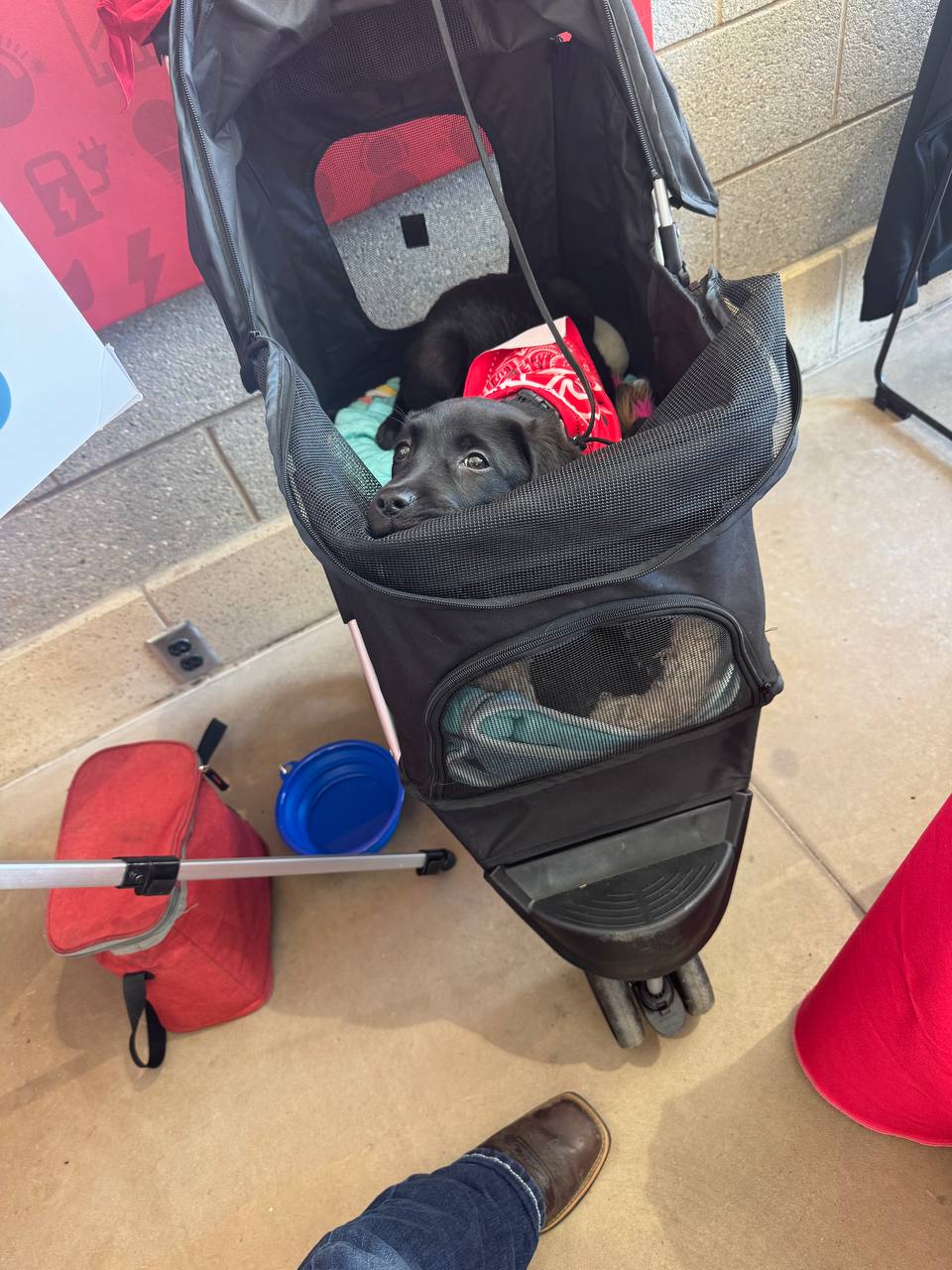
If you had asked me six months ago whether Puppy Jake Foundation would be putting service dogs in training in strollers, I would have laughed. If you had asked whether the idea would come from Renee, our director of training, I would have said absolutely not.
Yet, here we are. Welcome to the Stroller Brigade. And before you roll your eyes, hear me out. We were skeptics, too.
First, a little background.
At Puppy Jake, we limit where our Phase 1 puppies can go in public. We lovingly refer to the world outside our training environments as “the wild.” And for good reason. Puppies get overstimulated quickly. They’re still learning how to regulate their emotions and settle in unfamiliar environments. Add in the fact that Labrador and Golden Retriever puppies are ridiculously cute, and suddenly everyone wants to stop, pet and interact with them.
Even our best-behaved Phase 1 puppies are still puppies. They want to explore, sniff, tug, chew and do all the things puppies do. They haven’t developed the manners or skills they’ll need as service dogs.
For our volunteer fosters, managing all of that in public is a lot of work.
Enter a baseball game and a wild idea.
A few months ago, Renee was rushing out of the office to attend her son’s baseball game. She had a Phase 1 puppy in her care and was trying to figure out how to manage the service dog in training appropriately.
Then she remembered the strollers.
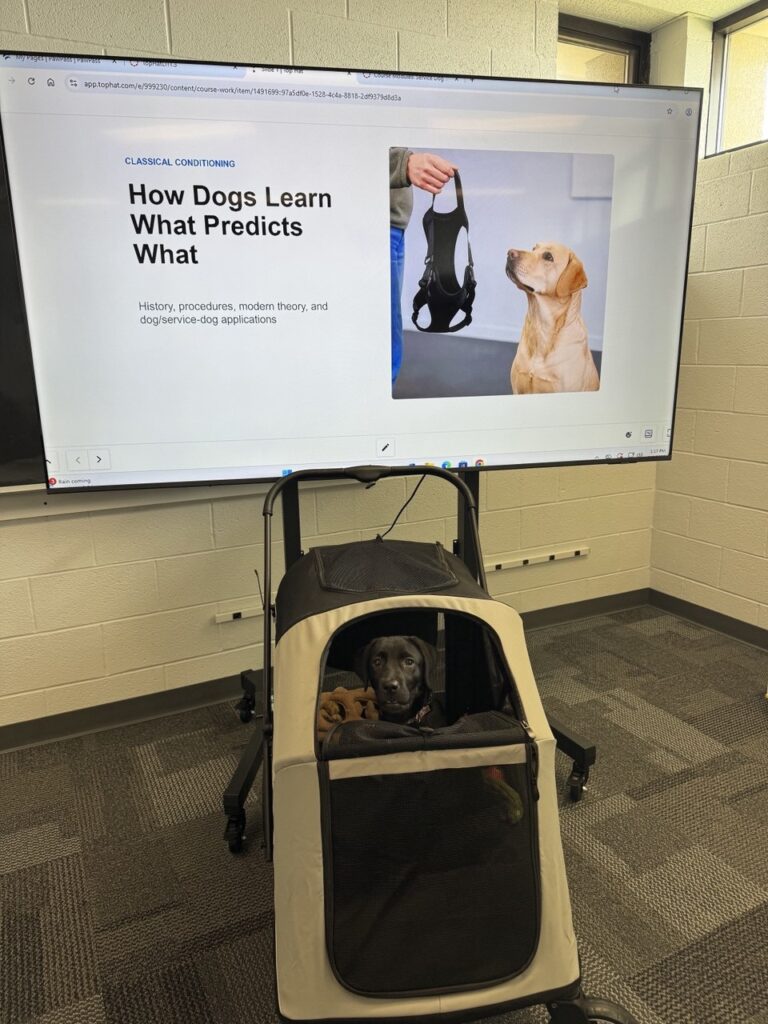
Yes, we had dog strollers. They’d been tucked away in storage for years. Originally, we used them to transport puppies through airports when bringing several home from breeders. As our acquisition practices changed, we no longer needed them — until Renee decided they might be worth another look.
What followed was a series of email updates from the game. Not about the score, but about how the puppy was responding.
And the results surprised us.
The puppy experienced the sights, sounds and activity of a baseball game without being in the middle of everything. People asked questions, but there weren’t dozens of hands reaching down to pet the puppy.
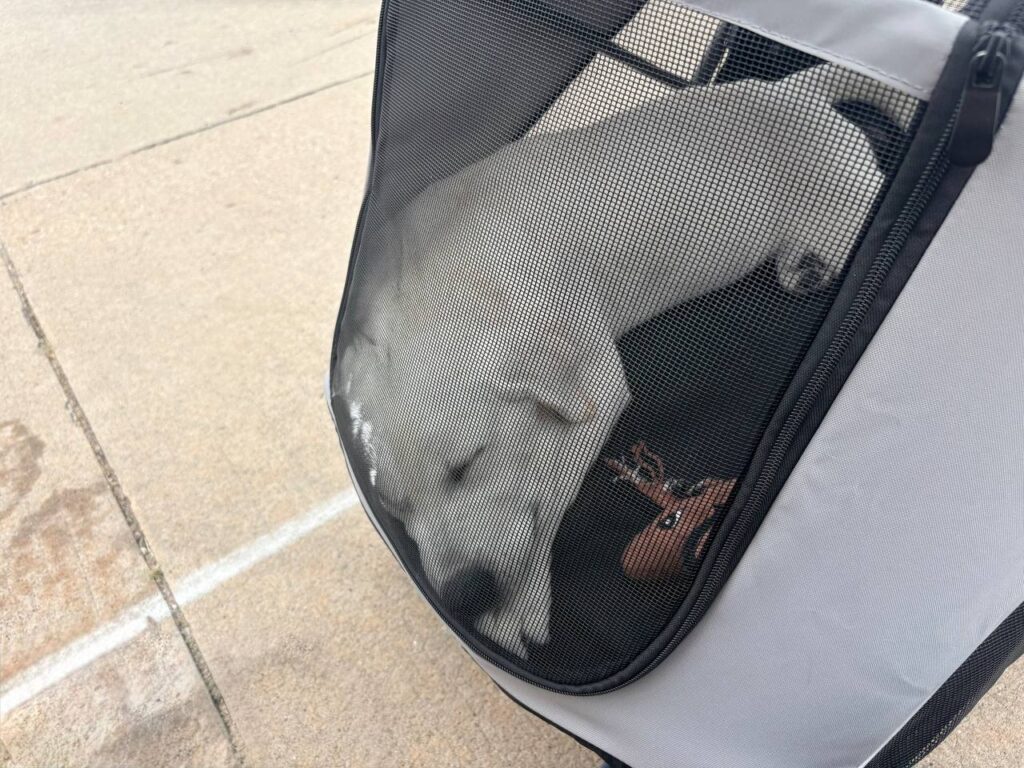
Renee, being Renee, took the puppy out for a little training. When she finished, she returned the puppy to the stroller. And the puppy settled. Even better, the puppy slept. That might not sound remarkable, but for us, it was a big deal.
Why does sleeping matter?
One of our challenges with young service dogs in training in public is helping them learn to settle. There is so much to see, hear and smell that they struggle to turn it all off.
That’s where something called latent learning comes into play.
Latent learning occurs without an immediate reward or obvious demonstration of a new skill. A puppy can take in information about an environment without being asked to perform a task. Rest and sleep also help the brain process and consolidate those experiences.
A puppy doesn’t need to interact with every person, sound or movement to learn about the world. Sometimes, simply experiencing an environment without becoming overwhelmed is valuable. The stroller gives us another way to introduce new experiences while helping puppies practice something equally important: doing nothing. For a future service dog, learning to settle while the world goes on around them is an essential skill.
But wait. We’re not suggesting everyone put their puppy in a stroller.
This isn’t a free pass to take Phase 1 puppies everywhere. And it certainly isn’t as simple as putting a puppy in a stroller and heading out the door. Our training team has developed a protocol defining when and how strollers may be used, which puppies are ready and how handlers should manage the experience.
The stroller is a temporary tool, used during a small window in a puppy’s development as we introduce public environments and build appropriate manners. It doesn’t replace training. It supports it.
Sometimes, we need to rethink what we think we know.
We know being a volunteer foster is hard. Raising a puppy that will someday become a service dog for a veteran comes with even more responsibility. We’re always looking for ways to make life a little easier for our volunteers while improving our training programs.
If a stroller allows a foster to attend a family activity without constantly managing an overstimulated puppy, that’s a win. If it helps a puppy experience a new environment, practice settling and get some much-needed rest, that’s another win.
And if it helps us develop more confident, adaptable service dogs, that’s what matters most.
We’re already seeing encouraging results. In our most recent group, seven of ten puppies advanced to Phase 2. We certainly can’t attribute that success to strollers alone, but I do think our willingness to try new approaches, evaluate what works and make adjustments is part of what’s moving us forward.
Will everyone love seeing a puppy in a stroller? Probably not. We understand. Six months ago, we might have been among the first to question it.
But I also think we have to be willing to challenge our own assumptions. Just because we’ve always done something one way doesn’t mean there isn’t another approach worth considering. That doesn’t mean throwing out what we know about training. It means being open to learning something new.
Sometimes that means dusting off a stroller that’s been sitting in storage for years. Turns out, you really can teach an old dog new tricks.